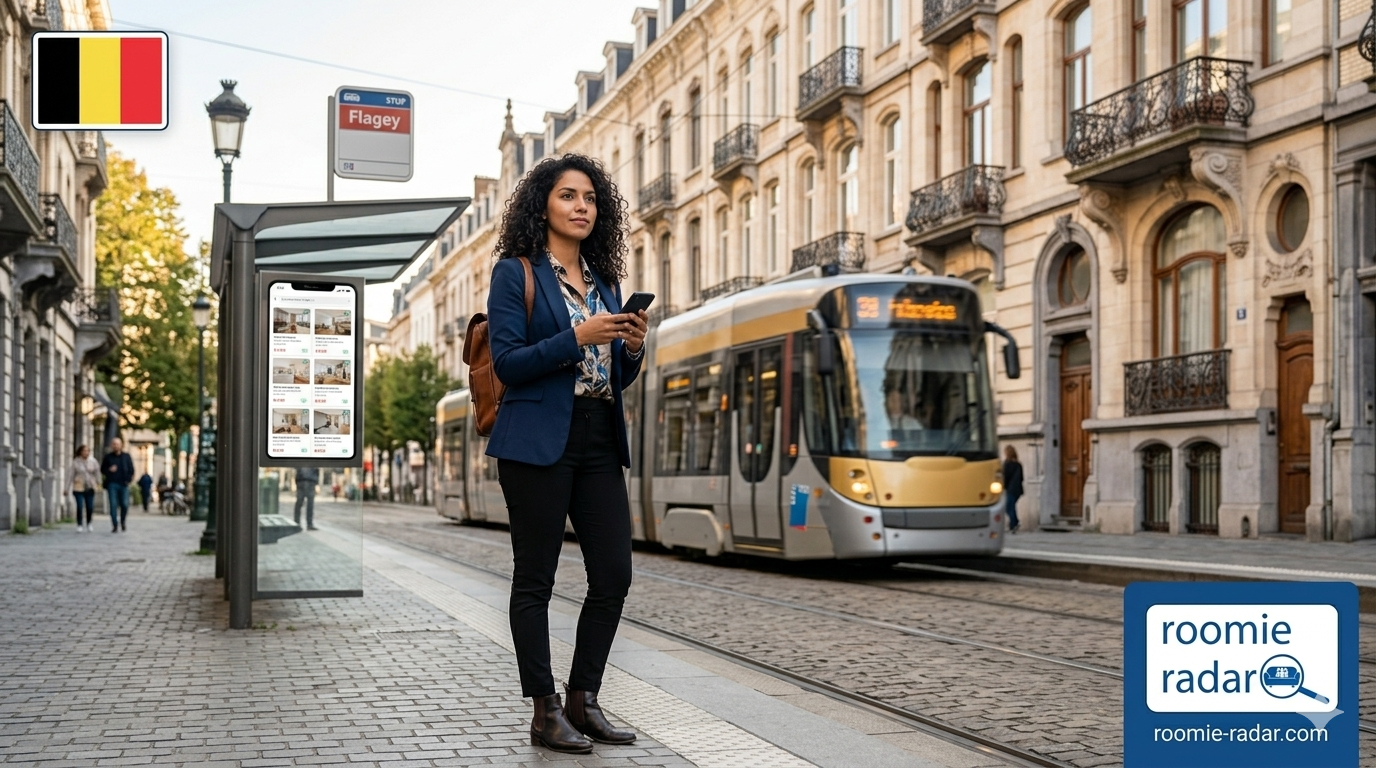
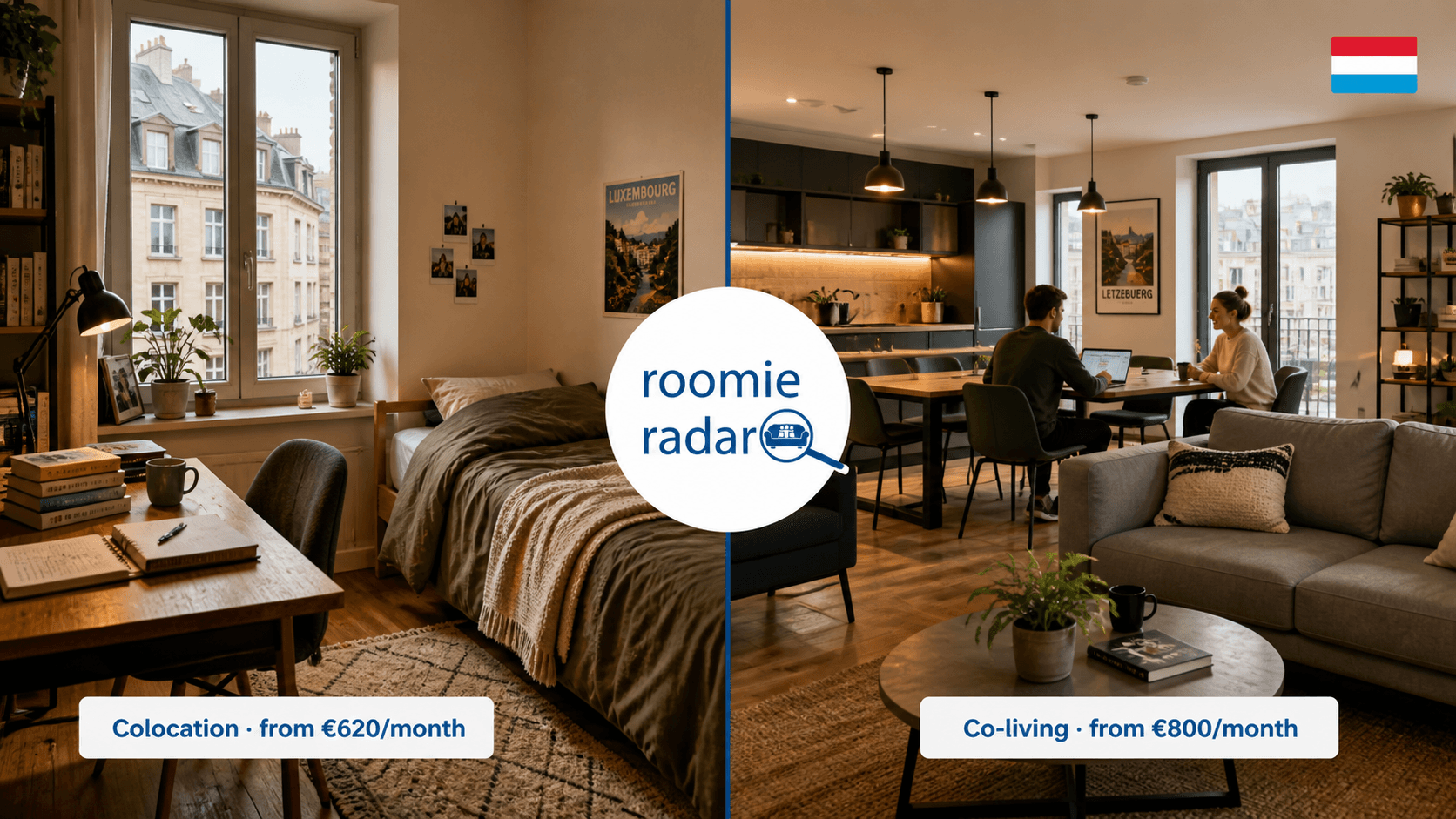
There is a conversation that plays out constantly among newly arrived expats in Brussels: someone picks their neighbourhood based on what colleagues told them, signs in Ixelles because "that's where everyone lives," and realises three months later they could have lived just as well in Saint-Gilles for €200 less per month with the same commute time.
Brussels has 19 communes. Most newly arrived expats hear about four. And within those four, they make decisions based on reputation rather than actual shared room in Brussels price data.
This article does what nobody has done yet from the perspective of someone looking for a room — not a full apartment, not buying, not a tourist itinerary — but a neighbourhood-by-neighbourhood comparison for someone arriving in Brussels with a work contract, a defined budget, and two weeks to get settled.
Real Room Prices by Neighbourhood in Brussels 2026 💶
Before the detail, the market data as we see it through Roomie-Radar:

The gap between the most expensive and most accessible options runs €200–€400/month. Over 12 months, that's up to €4,800. And in many cases, the commute difference is only 15–20 minutes by metro or tram.
Renting in Brussels as an Expat: Rental Contracts Belgium, Deposits, and the 3-6-9 System Nobody Explains
Etterbeek: The EU Institutions Neighbourhood 🇪🇺
If you work at the European Commission, Parliament, Council, or any other EU institution around Schuman, Etterbeek is the most logical option by proximity. The Cinquantenaire Park, the Art and History Museum, Schuman square — all within ten minutes on foot from most streets in the commune.
One figure that rarely appears in guides: expats make up 49% of Etterbeek's population, making it literally the most international commune in Brussels. That has advantages — newcomer-oriented services, diverse community, active social life — and one consistent disadvantage: demand for rooms in Etterbeek Brussels is extremely high and listings disappear within days.
A shared room in Etterbeek runs €700–950/month. Not the cheapest. But for someone working ten minutes on foot from Schuman square, the time and transit savings offset part of the premium.
Picture this: you arrive in Brussels on Monday, your contract starts Wednesday, and you still don't have a room. In Etterbeek, with a quick search process and a platform with verified listings, you can have the keys before the weekend. In Saint-Gilles or Forest too — but the process requires more advance preparation.
Best profile: EU institution professionals, diplomats, researchers. Families with children in nearby international schools.
Ixelles: The Neighbourhood with Multiple Faces 🌿
Ixelles is not one neighbourhood — it's a collection of micro-areas with entirely different prices and profiles, and treating them as one is the most common mistake newly arrived expats make.
The university zone (VUB, ULB) has more affordable rooms and a clearly student-oriented atmosphere, with prices dropping to €700 in some streets. Châtelain and Flagey are more expensive — €850–€1,000/room — with an active neighbourhood life, a weekly market, and quality cafés. The part of the EU Quarter that falls within Ixelles connects well with institutions but pricing sits at the upper end.
For someone with a tighter budget who wants to live in Ixelles, the key is exploring the Boondael area or streets north of the Ixelles cemetery — where prices drop to €720–800 without losing connectivity.
Half of Ixelles' population is international. In practical terms: English and French services in almost every establishment, an established and active expat network, and a density of work and networking opportunities that no other Brussels neighbourhood can match.
Best profile: Finance and consulting professionals (Avenue Louise), postgraduate students (VUB/ULB), flexible-budget profiles prioritising neighbourhood quality of life.
Saint-Gilles: The Choice of People Who Have Been in Brussels a While 🎨
Saint-Gilles is the neighbourhood mentioned most by Roomie-Radar users in Brussels who have been in the city for at least a year. It's not the one they chose on arrival — it's the one they choose when they move again.
Shared rooms in Saint-Gilles Brussels run €600–800/month. The tram connects with Ixelles, the centre, and Louise in 10–15 minutes. The Art Nouveau architecture is omnipresent. And the concentration of cafés, restaurants, and cultural life around Parvis de Saint-Gilles has no equivalent in any similarly-priced neighbourhood.
It's cheaper than Ixelles. Significantly cheaper. And functionally equivalent for most roles in the centre and European Quarter.
The honest downside: some streets in southern Saint-Gilles, particularly around Porte de Hal, have a livelier night-time atmosphere. As with any genuinely diverse urban neighbourhood, checking the specific street before committing to a listing matters. Roomie-Radar listings specify the exact property location.
Best profile: Young professionals on tighter budgets, designers, NGO workers, early-career positions in international organisations.
Roomie-Radar Launches in Belgium: Why Brussels Was the Obvious Next Move (and What We Learned in Luxembourg)
Forest: The Smart Call That Few People Make 🔍
Forest features in very few expat guides for Brussels. Precisely for that reason, it deserves attention.
Rooms in private flatshares and co-living in Forest start from €600 and rarely exceed €780/month. Tram 81 and several bus lines connect to the centre, Ixelles, and Saint-Gilles without difficulty. Forest Park — the largest within the Brussels municipality — is a green asset that neither Ixelles nor Etterbeek can match.
For an expat arriving in Brussels with a work contract and a clear budget, Forest is the Brussels equivalent of Bonnevoie in Luxembourg: cheaper, equally functional, better value per euro spent. Several active urban regeneration projects are gradually reshaping its identity, and the arrival of co-living operators confirms the neighbourhood is in a positive transition.
Best profile: Budget-conscious professionals, early-career expats, NGO workers with offices in southern Brussels.
Schaerbeek: The Most Underrated of All ⬆️
Schaerbeek has a reputation among expats who don't know it. The reality in 2026 is considerably more nuanced.
With rooms from €550/month, excellent metro and train connections from Gare du Nord, and a food and cultural scene that has been improving for years, Schaerbeek offers the most competitive pricing of any well-connected neighbourhood in Brussels. Domicile registration is entirely viable — worth clarifying because some expats assume cheaper neighbourhoods have administrative restrictions. They don't.
For a PhD student, an intern at an international organisation with a limited budget, or a young professional on their first Brussels contract, Schaerbeek offers the most savings without sacrificing functional connectivity.
Uccle: For Those Who Want Quiet Without Leaving Brussels 🌳
Uccle is the most residential option on this list. Quiet, green, with good international schools nearby and room prices between €700 and €900/month. Not the most exciting neighbourhood for a young professional arriving alone, but for families or anyone prioritising calm over neighbourhood social life, the arguments are solid.
The connection to the centre is good by tram and bus, though less direct than from Etterbeek or Saint-Gilles. Metro doesn't reach Uccle — that's the data point that weighs most for anyone working in the centre or the European Quarter.
How Roomie-Radar Helps You Search by Neighbourhood in Brussels 🔎
The difference between knowing theoretically that Saint-Gilles is cheaper than Ixelles and actually finding a verified room in Saint-Gilles while searching remotely for two weeks is significant.
On Roomie-Radar, we list verified rooms across all the neighbourhoods above — Etterbeek, Ixelles, Saint-Gilles, Forest, Uccle — with clear information on monthly price, included utilities, minimum duration, and whether domicile registration is confirmed. Using Roomie-Radar is free.
For landlords with available rooms in Brussels: the user profile that arrives through Roomie-Radar is, in over 85% of cases, a quality lead — an expat with genuine urgency, actively searching, ready to sign within days. Less time spent on unqualified candidates, more efficiency in every selection process.
The Verdict: Which Neighbourhood Based on Your Profile?
Without overcomplicating it:
You work at EU institutions (Schuman, Parliament, Council): Etterbeek is closest; Saint-Gilles via tram saves €150–200/month.
You work in finance or consulting (Louise, Ixelles business district): Saint-Gilles by tram is the best price-to-commute equation.
You're a student or on your first contract: Saint-Gilles or Schaerbeek, clearly.
You prioritise quiet: Uccle or Forest.
You're arriving with a very tight budget: Schaerbeek is the name to search.
One Brussels-specific factor that doesn't exist in Luxembourg: public transport has a cost. A monthly STIB/MIVB unlimited pass costs €49.50 for the Brussels-Capital Region. That's part of the full monthly budget calculation — a room €150 cheaper in Schaerbeek with a monthly transit pass can still be the better financial outcome compared to walking distance in Etterbeek.
Conclusion
Finding the right room in Brussels isn't about picking the "best" neighbourhood in the abstract. It's about mapping your workplace, your real budget, and how much commute time you're willing to trade for cost savings.
Etterbeek and the EU side of Ixelles are the most convenient for EU institutions but carry a clear premium. Saint-Gilles offers the best price-to-quality equation for most profiles. Forest and Schaerbeek are the smart calls for those prioritising savings. And Uccle is for those who want Brussels with calm.
Roomie-Radar lists verified rooms across all these neighbourhoods. Search by area, compare real prices, and arrive in Brussels with your housing already sorted: roomie-radar.com/rooms.
FAQ 📊
1. What is the cheapest Brussels neighbourhood for a shared room?
Schaerbeek offers the lowest prices among well-connected neighbourhoods, with rooms from €550/month. Forest and Saint-Gilles follow closely (€600–780) with strong tram and bus networks. For an expat on a tight budget, any of these three offers more value than Ixelles or Etterbeek at the same functional connectivity level.
2. What is the best Brussels neighbourhood for working at EU institutions?
Etterbeek is the closest commune to the EU institutions in the Schuman/Montgomery/Cinquantenaire axis, with 49% of its population being expats. Ixelles (EU Quarter zone) is the second proximity option. Both are more expensive than Saint-Gilles, which offers a 20-minute tram connection for €150–200/month less.
3. Is Saint-Gilles safe to live in?
Saint-Gilles is generally a safe and active neighbourhood, though with internal variation. Areas around Parvis de Saint-Gilles and Châtelain are lively and popular. Some streets near Porte de Hal have more night-time activity. As with any genuinely diverse urban neighbourhood, checking the specific street of a listing before committing matters. Roomie-Radar listings specify the exact property location.
4. Can I register my domicile in any Brussels neighbourhood?
Yes — in all communes of the Brussels-Capital Region, domicile registration is possible provided the rental contract authorises it. Registration is mandatory in Belgium to access social security, health insurance, and other services. The issue is not the neighbourhood but the contract type — some informal or subletting arrangements don't allow it. On Roomie-Radar, domicile registration status is specified in each listing.
5. How much does public transport cost in Brussels?
Unlike Luxembourg, public transport in Brussels has a cost. A single STIB/MIVB ticket costs €2.10. A monthly unlimited pass costs €49.50 for the Brussels-Capital Region. This factors into the full monthly budget calculation when comparing neighbourhoods — a room €150 cheaper in Schaerbeek with a monthly pass can still be the better financial outcome compared to no transit cost in Etterbeek.
6. How fast do shared rooms rent in Brussels?
In high-demand areas — Etterbeek, Ixelles, Saint-Gilles — well-priced rooms disappear in 5 to 15 days of listing. In Forest, Schaerbeek, or Uccle, the timeframe extends to 15–25 days. Searching with less than two weeks' notice in premium zones is genuinely risky. With verified listings on Roomie-Radar, time lost on already-occupied or non-existent listings is eliminated.
7. Is Forest a good neighbourhood for expats in Brussels?
Forest is an underused option worth more attention. Competitive pricing (€600–780/room), good tram and bus connections, Brussels' largest municipal park, and a growing young professional community. It lacks Saint-Gilles' neighbourhood buzz and Etterbeek's institutional proximity, but for an expat working in southern Brussels or seeking the best value per euro, Forest is hard to beat in this price range.
8. What is the difference between Ixelles and Saint-Gilles for expats in Brussels?
Both are popular with expats but with distinct profiles. Ixelles has more expensive zones (Châtelain, Flagey, EU Quarter) with a higher concentration of institutions and universities — average room price €750–1,000. Saint-Gilles is more affordable (€600–800), more socially diverse, with an alternative cultural scene and direct tram connection to Ixelles and the centre. For tighter budgets, Saint-Gilles offers more for less.
9. Does Roomie-Radar have rooms available in Brussels neighbourhoods?
Yes. Roomie-Radar lists verified rooms in the main Brussels expat neighbourhoods — Etterbeek, Ixelles, Saint-Gilles, Forest, and Uccle. All listings include clear information on price, included utilities, minimum duration, and domicile registration conditions. Filter by neighbourhood directly at roomie-radar.com/rooms.