Renting a room in Ghent or Antwerp: how Flemish rental rules differ from Brussels
Renting in Ghent or Antwerp? Deposit caps, EPC-linked indexation, and the Flemish rules that aren't the same as Brussels.
31/08/2026

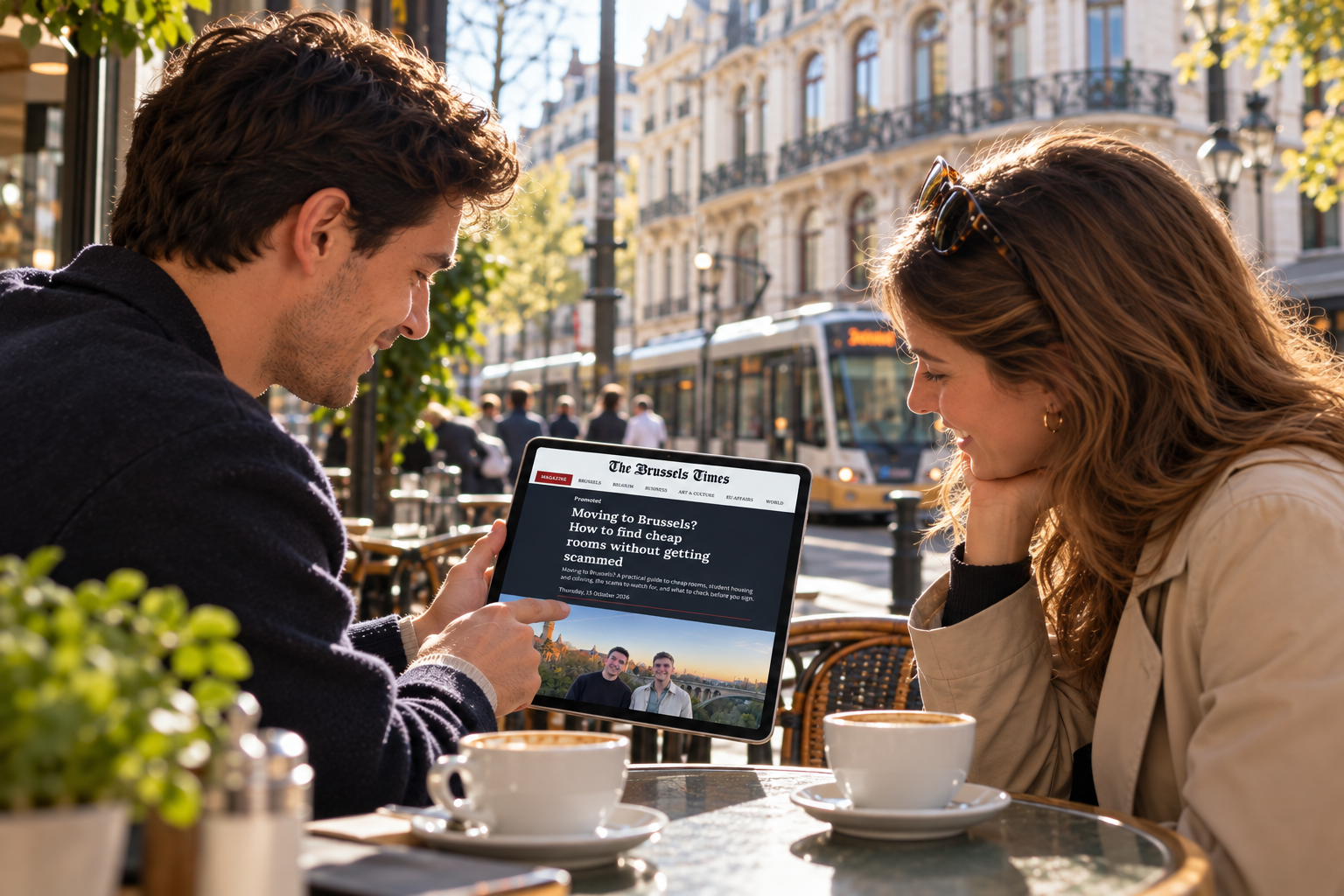
On 15 October 2026, The Brussels Times published a feature with the two co-founders of Roomie-Radar: "Moving to Brussels? How to find cheap rooms without getting scammed". The paper is a milestone for us: the story that started in Luxembourg now reaches, in English, the people about to land in Brussels. You can read it in full at brusselstimes.com.
A practical guide for anyone moving to Brussels, written with the co-founders, on how to find cheap rooms in Brussels and avoid scams. It covers six topics: when to start looking, what you'll pay, what the Belgian terms in listings mean, six scam red flags, what to check before signing, and where Roomie-Radar fits in.
The Brussels Times describes itself as Belgium's largest daily news media in English, with over two million visits a month and an audience of expats, foreigners and internationally minded Belgians. That is exactly the reader who arrives in a new city and needs housing fast.
It started from a problem we lived ourselves: finding a room from another country without knowing which listings were real. Both founders arrived in Luxembourg as Spanish expats in 2021. Salvador spent weeks searching from Spain, and every reply was either "it's already taken" or "can you come and see it tomorrow?" He ended up in the only room left: the one next to the kitchen, in a house with twelve people.
Javier sums it up: the hard part was knowing which listings were real, and dealing with the landlord directly instead of paying an agency a cut. We launched Roomie-Radar in Luxembourg in early 2024 and in Belgium in April 2026, starting with Brussels. What the press documented about that market is in Roomie-Radar in Luxembourg Times.
Based on the rooms listed on Roomie-Radar, a furnished room in a shared flat in Ixelles, Etterbeek or around the European Quarter usually costs between €650 and €900 a month. That is the range on our platform, not an official market average. Saint-Gilles, Schaerbeek and Anderlecht tend to be cheaper.
Coliving costs more, but the room comes with bills, Wi-Fi and cleaning included, and many operators offer short leases of three to six months. To check whether a specific offer is reasonable, compare it with the Brussels rent grid. And always check what the rent includes: heating, electricity and internet add up quickly when billed separately.
Six to eight weeks before you arrive, if you can. The market has two rush periods: July to August, when students and EU trainees arrive for the September intake, and January to February, ahead of the spring semester and the March traineeships. In those weeks a good room in Ixelles or Saint-Gilles can be gone within a day or two.
Do viewings by video and have your documents ready: ID, work contract, payslips, and a university or traineeship letter. If you can, spend a few days in Brussels before moving: landlords tend to choose people who can visit in person, a lesson Salvador learned in Luxembourg.
They are the Belgian names for a student room and a shared flat, and they change with the language of the ad. A kot is a student room, a colocation is a flatshare (the French term), studentenkamer and koten are the Dutch terms, and chambre à louer means room for rent.
Much of this demand is student housing, and not only in Brussels: Namur, Ghent, Antwerp, Leuven and Liège each have their own market. If you are comparing cities, see student room prices in Ghent, Antwerp, Leuven and Liège.
Most rental scams in Brussels look alike. Be careful if:
A real landlord won't mind waiting until you've seen the room. Don't send money to someone you haven't met or can't verify. It is the same advance-payment pattern we saw again and again in Luxembourg.
Five things, in writing. Read the lease and check the length fits your plans. Ask how the deposit will be held: in Brussels you can place it in a blocked bank account in your own name instead of handing it to the landlord in cash, and the federal economy ministry advises against deposits handed over personally. Details are in renting in Brussels as an expat.
Ask for a detailed check-in inventory with photos, the état des lieux, which saves arguments when you move out: how to do it in a shared room. Make sure you can register your address at the commune (the Belgian town hall): without it you can't get your residence card and opening a bank account gets harder. And remember that tenant insurance is mandatory in Belgium, including for a single room.
Rooms are listed by landlords, agencies and coliving operators, and anyone searching builds a profile before applying, so landlords know who they are dealing with. Verified listings carry a badge so you can tell them apart at a glance. For landlords, a listing that says what the price includes and whether you can register at the address saves wasted messages and viewings.
For anyone searching, the first useful question is always the same: is this listing real, and can I talk to the landlord directly? Many of our users tell us that is what takes the most time to settle when they arrive. Roomie-Radar connects landlords with qualified users, and using Roomie-Radar is free: no agency fees, no subscription.
Deepening our presence in the country's main university and expat cities while keeping a wide selection of verified rooms as the priority. We started in Brussels and are building coverage across Ghent, Antwerp, Leuven and Liège. Our focus remains Luxembourg and Belgium, and the next step is opening other European markets, such as Spain and Norway.
Appearing in The Brussels Times, even as sponsored content, lets us tell people arriving in Brussels what we learned in Luxembourg: that finding a room is mostly a problem of information, timing and knowing which listings are real. The advice is simple and holds even if you never use our platform: start early, compare prices, never pay unseen and get everything in writing.
If you are about to move, browse verified rooms in Belgium at roomie-radar.com and read the full feature at brusselstimes.com.
1. Where can I read the Roomie-Radar article in The Brussels Times?
It is on brusselstimes.com, titled "Moving to Brussels? How to find cheap rooms without getting scammed", published on 15 October 2026. It is an English-language feature written with Roomie-Radar's two co-founders.
2. How much do cheap rooms in Brussels cost?
Based on the rooms listed on Roomie-Radar, a furnished room in a shared flat in Ixelles, Etterbeek or around the European Quarter usually costs between €650 and €900 a month. Saint-Gilles, Schaerbeek and Anderlecht tend to be cheaper. That is the range on our platform, not an official average.
3. When is the best time to look for a room in Brussels?
Six to eight weeks before you arrive. The rush periods are July to August and January to February, and in those weeks a good room can be gone within a day or two.
4. What is a kot and what is a colocation?
A kot is a student room in Belgium and a colocation is a flatshare, in French. In Dutch ads you'll see studentenkamer and koten, and in French ads chambre à louer.
5. How can I tell if a room offer in Brussels is a scam?
Be careful if they ask for money before you see the room, charge a €100 to €200 reservation fee, say the landlord is "abroad" and will post the keys, offer a price far below the area, refuse a video call, or ask for your passport or bank details too early.
6. Can I pay a reservation fee before seeing the room?
No. A real landlord will wait until you've seen the room, in person or on a live video call. Don't send money to someone you haven't met or can't verify.
7. Where is the deposit kept in Brussels?
You can place it in a blocked bank account in your own name instead of handing it to the landlord in cash. The federal economy ministry advises against deposits handed over personally.
8. Why do I need to register my address at the commune?
Because residence paperwork requires it: without that registration you can't get your residence card, and opening a bank account gets harder. Before signing, confirm that the contract lets you register the address.
9. Is Roomie-Radar free?
Yes. Using Roomie-Radar is free: no agency fees, no subscription. You filter by budget, area and length of stay, then apply online.
Renting in Ghent or Antwerp? Deposit caps, EPC-linked indexation, and the Flemish rules that aren't the same as Brussels.

Renting out a room in Wallonia? What the permis de location is, what it costs in 2026, and the fine you risk without one.
Coliving or flatshare in Brussels? Real prices, the colocation pact, and when each option actually makes sense before you sign.

Do you need tenant insurance in Luxembourg? It isn't required by law, but almost no lease gets signed without it. Here's why.
