There's a thread that reappears every few weeks on r/belgium. The titles vary but the story is always the same: someone who spent a year in Brussels, kept the room clean, left without unpaid rent — and lost between €500 and €1,500 of their rental guarantee because the exit inspection didn't match the entry one.
This isn't bad luck. It's a predictable outcome of signing a document without understanding what it covers.
In Belgium, the état des lieux — the property inspection conducted at entry and exit — is not a bureaucratic formality. It's the document that determines who's right when a landlord and tenant disagree about the condition of a room. For any expat arriving in Brussels without prior experience of the Belgian rental system, the rules are the ones nobody explains before you sign.
At Roomie-Radar, we've seen this pattern since the first weeks after launching in Belgium. Verified listings reduce exit disputes. But a properly done entry inspection is the most powerful tool a tenant has — and it costs nothing.
What the état des lieux is in Belgium and why it isn't optional
The état des lieux is a document recording the condition of the property — or in a shared flat, the room — at the moment keys are handed over. It exists at two moments: on entry (état des lieux d'entrée) and on departure (état des lieux de sortie).
In Brussels, the governing framework is the Ordonnance du Code du Logement bruxellois and its 2024 updates. The key rules:
The entry inspection must be completed within 15 days of taking possession of the property. If the landlord doesn't propose it within that window, the tenant can demand it — and if the landlord still doesn't act, the tenant can request that a court-appointed expert carry it out. The cost falls on the landlord.
There is no legal requirement in Brussels for the état des lieux to be conducted by a certified expert. It can be written jointly by the landlord and tenant. But both parties must be present, or represented, and must sign the document. An inspection drafted unilaterally by the landlord and sent to the tenant for remote signature does not carry the same probative value as one signed in person by both parties.
This is the detail that makes the difference in the majority of exit disputes.
What a valid état des lieux must include in a shared room
The most common mistake in a Brussels flatshare is confusing the inspection of the whole flat with that of the individual room. In a shared property, you have rights and responsibilities over your private room — and shared responsibility over common areas.
A properly done entry inspection must include:
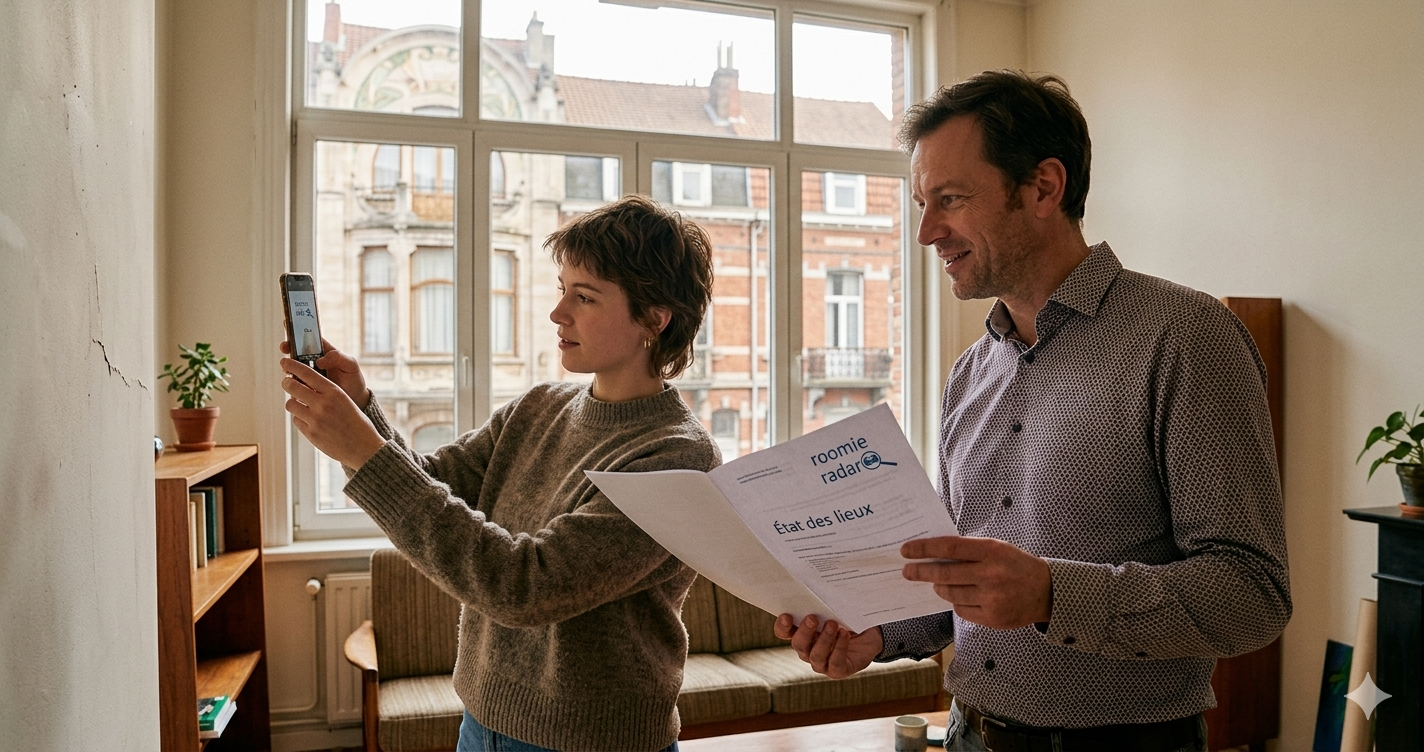
Per room: condition of walls, floor, ceiling, windows, shutters, door and lock, light points, sockets, and any furniture included in the contract. Photographs with an embedded date — not just in your phone gallery, but ideally attached to a signed document.
Common areas: kitchen (appliances, furniture, general condition), bathrooms (fittings, tiles, taps), hallways, living room if applicable, and utility meters if accessible.
General property information: full address, date of inspection, full names of all parties present, number of keys handed over.
What must never be missing: an observations section where the tenant can note any pre-existing defect not recorded by the landlord. This section often doesn't appear in the printed templates some landlords bring to the inspection. You have the right to add it.
Renting in Brussels as an Expat: Rental Contracts Belgium, Deposits, and the 3-6-9 System Nobody Explains
The 15 days that matter most in your tenancy
Imagine you arrive at your new room in Ixelles on a Monday. The left wall of the bedroom has a damp mark in the upper corner — small, but visible. The landlord doesn't mention it in the état des lieux. Neither do you, because you don't know you have the right to add observations.
Eleven months later, at the état des lieux de sortie, the mark is still there. The landlord claims you caused it. You say it was already there when you arrived. Without a written record, the burden of proof falls on the tenant.
This scenario repeats itself constantly — with damp patches, wall marks, scratched wooden floors, appliances that didn't work properly from day one, broken shutters, keys that never quite locked. These are pre-existing defects that become exit disputes because nobody documented them at entry.
The solution is simple, but it has a deadline: you have 15 days from key handover to request changes to the entry inspection or to add observations. After that window closes, the document is binding.
What to do on move-in day:
Conduct the inspection in person with the landlord or their representative. Photograph every room with your phone, ensuring the images carry date metadata. Email the photographs to the landlord the same day — this creates a timestamped record. If you spot any defect not in the document, write it on paper, sign it, and ask the landlord to co-sign. If the landlord isn't available, send it by registered mail within the 15-day window.
What to do if there's a dispute on exit: the Service de Conciliation Locative
Brussels has a service that most arriving expats have never heard of: the Service de Conciliation Locative of the Brussels-Capital Region.
It is a public service, free of charge, available to any tenant or landlord with a rental contract in the Brussels-Capital Region. Its purpose is to mediate disputes between landlord and tenant — including disagreements over the exit inspection, the return of the rental guarantee, and the condition of the room at departure.
The process is voluntary for both parties: the landlord is not obliged to participate. But when they do, the rate of resolution without going to the Juge de Paix is high. And the simple act of having requested conciliation creates an official record that can be relevant if the case proceeds to court.
For any expat in a Brussels shared room facing an exit dispute, this service exists before paying a lawyer. Official information is available at be.brussels.
How Roomie-Radar reduces exit disputes
At Roomie-Radar, all listings are verified before being published. That doesn't eliminate exit disputes — no platform can guarantee that — but it does reduce the baseline risk.
A landlord with a verified listing on Roomie-Radar has a platform track record. Tenants are qualified users with complete profiles. When both parties enter the rental relationship with transparency from the start, end-of-tenancy disputes are less frequent and less contentious.
Brussels Neighbourhoods for Expats: What Room for Rent in Brussels You Can Actually Afford Based on Where You Work
Conclusion
The état des lieux in Belgium is not paperwork you sign because you have to. It is the document that decides whether you recover your rental guarantee when you leave — which in Brussels means two months' rent held in a blocked account.
Doing it properly takes an hour on move-in day. Not doing it properly can cost you between €500 and €1,500 on the way out.
At Roomie-Radar we publish verified listings of shared rooms in Brussels so that every tenancy starts from the most transparent foundation possible. Start at roomie-radar.com or go directly to roomie-radar.com/rooms.
FAQ 📊
1. Is an état des lieux mandatory in Belgium?
In the Brussels-Capital Region it is mandatory for all primary residence rental contracts. It must be completed within 15 days of key handover. If the landlord doesn't propose it, the tenant can demand it. Without an entry inspection, the property is legally presumed to have been in good condition at the start of the contract — which can create ambiguity for both parties in an exit dispute.
2. Who pays for the état des lieux in Belgium?
If conducted jointly by landlord and tenant without an expert, there is no cost. If both parties agree to hire an external expert, the cost is split equally. If a court-appointed expert carries it out because the landlord failed to act within 15 days, the cost falls on the landlord.
3. Can I add observations to the état des lieux after signing?
Yes, within 15 days of key handover. After that window, the document is binding and cannot be unilaterally modified. This is why it's essential to review the entry inspection carefully on the day you move in — and not to sign it until it accurately reflects the actual condition of the room.
4. What happens if the landlord and I disagree on the exit inspection?
You have two options before hiring a lawyer: request mediation through the Service de Conciliation Locative (free, Brussels-Capital Region) or go to the Juge de Paix. The conciliation service is the recommended first step — it is fast, free, and resolves most cases without going to court.
5. How long does the landlord have to return the rental deposit in Brussels?
Once the exit inspection is signed and any deductions agreed, the landlord must return the rental guarantee within a reasonable period. If there is a dispute, the timeline is interrupted until resolution. The guarantee is held in a blocked account in the tenant's name — the landlord cannot access it without the tenant's agreement or a court order.
6. What's the difference between an état des lieux for a flatshare and for a whole flat?
In a Brussels flatshare, the inspection must distinguish between each tenant's private room and the common areas. Responsibility for the private room is individual; responsibility for common areas is shared among all co-tenants. If the colocation agreement doesn't specify this distinction, liability may be treated as joint — meaning damage in the living room caused by another tenant could affect your deposit.
7. Can I do the état des lieux alone if the landlord doesn't show up?
Not with full legal validity. A unilateral inspection — drafted by one party alone — has limited probative value in a dispute. If the landlord doesn't appear at the agreed time, the correct procedure is to request a court-appointed expert through the Juge de Paix. In practice, most situations are resolved before reaching that point once the tenant asserts their rights formally.
8. Does Roomie-Radar offer rooms in Brussels with the état des lieux included?
Roomie-Radar connects tenants with landlords through verified listings in Brussels. The état des lieux is an agreement directly between landlord and tenant and is not part of the platform process — but all verified listings come from landlords with a platform track record, which significantly reduces disputes compared to unverified listings on Facebook groups or unfiltered portals. Using Roomie-Radar is free.
9. Is the rental guarantee the same as a deposit in Belgium?
Yes. In Belgium, the garantie locative is capped at two months' rent (for primary residence contracts in Brussels) and must be deposited in a blocked account in the tenant's name at a financial institution. The landlord can only access it with the tenant's agreement or a court order — never unilaterally.
10. Can I claim damages from the landlord if the room was in poor condition on arrival?
Yes, if you have the entry inspection documenting it. Without that document, the burden of proof is very difficult to sustain. With it, you can file a formal claim — first through the Service de Conciliation Locative, and if no agreement is reached, before the Juge de Paix. Prescription periods in Belgian rental law are one year from the end of the contract.